Yoboeew Dog Puzzle Toys Interactive IQ Treat Training (Level 1-3) Review (2026)
Updated September 14, 2026 · Research-based review
Our verdict
A good entry level brain game for puppies, small dogs or clever cats in an apartment, with three difficulty levels that let a pet build up from easy to harder rounds. It is not built to survive a determined chewer, so it works best as a supervised activity rather than a toy left out unattended.
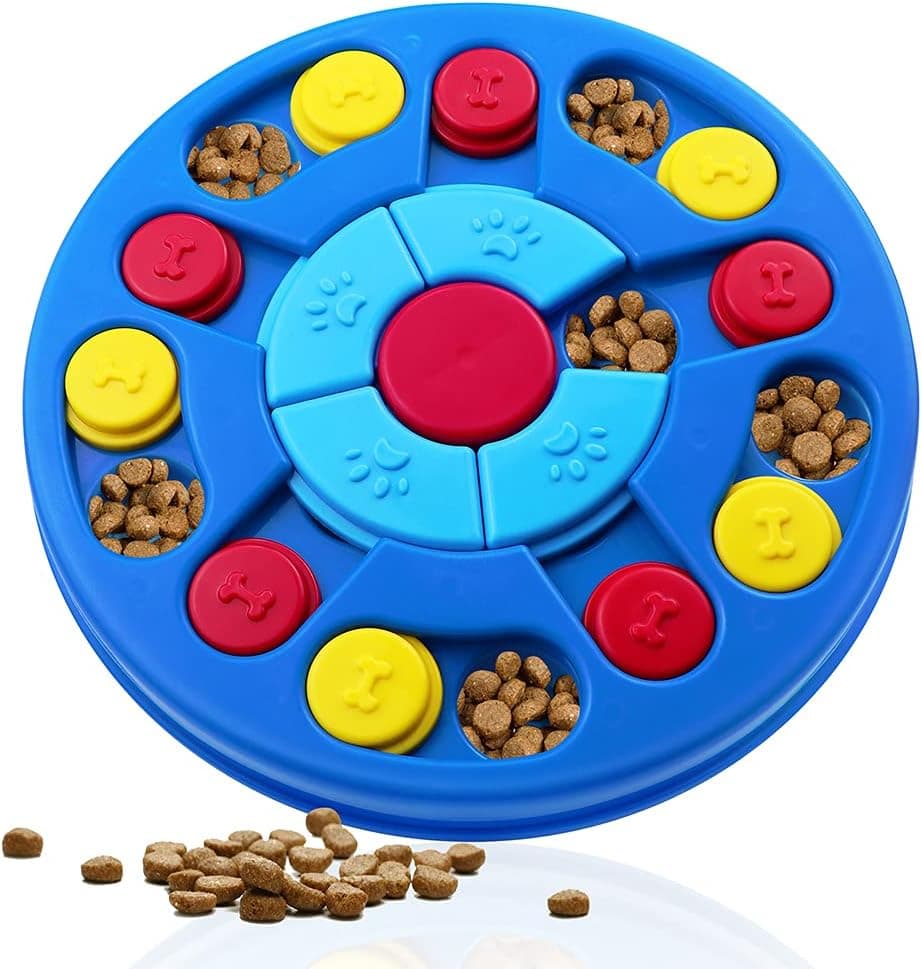
Yoboeew's interactive dog puzzle toys for IQ treat training, offered in Level 1-3 difficulty options.
Price range: See on Amazon
What we liked
- + Level 1 to 3 options let you scale difficulty as dogs learn
- + Treat training builds focus and problem-solving skills
- + Clear levels help owners pick a starting point
Trade-offs
- - Smart dogs may master easier levels quickly
- - Loose puzzle pieces can be lost or chewed
Who should consider this puzzle
This toy is aimed at owners of puppies, small dogs and cats who want a structured way to work on mental stimulation rather than a simple chew toy. Listings for the product describe fifteen holes across the puzzle base, each covered by a sliding piece that the pet has to nudge aside with a paw or nose to reach the treat underneath. Because it is sold with three difficulty levels rather than one fixed layout, it gives an apartment dweller a way to start a pet on an easy round and work up as the animal gets better at the game, which suits a household easing a new puppy or a nervous cat into puzzle feeding rather than throwing them straight at a hard toy.
How the levels and design work
According to the listing, levels one and two are built as easier steps meant for puppies, cats and small dogs, while the higher level adds more sequential steps that take longer to figure out for a dog that already understands the basic game. Reviewers describe roughly fifteen to twenty minutes of active play per session before a dog solves the puzzle, which is a reasonable stretch of focused activity for an apartment routine without demanding constant supervision beyond that window. The puzzle base is described as a bigger size than some competing toys, finished in navy blue, red and yellow, so it reads clearly against most flooring and is easy to spot if a piece ends up under furniture.
Living with it day to day
Setup is straightforward: treats or dry food go into the holes, the sliders are pushed back into place, and the dog or cat works the sliders open one at a time. Because the pieces are loose rather than fixed to the base, they can be moved around between sessions to change up the pattern slightly, which helps keep a smart dog from simply memorizing where the treats always are. The listing is explicit that this is not an indestructible toy for a dog that likes to pick things up and chew, and recommends taking it away once the game is over rather than leaving it out as a permanent chew toy, which is worth factoring in for a household with a determined destroyer.
Where it sits against other puzzle toys
In this site's ranking of dog puzzle toys it lands near the top of the group, behind only a six piece puzzle set aimed at smart dogs and ahead of several treat dispensing slow feeders and enrichment toys. Its clear level system is the main edge over rivals like a plain treat dispensing puzzle or a slow feeder style toy, since those tend to offer one fixed difficulty rather than a built in progression. The trade-off is that loose sliding pieces are easier for a dog to pick up and carry off, or for a small piece to go missing under a couch, compared with a single molded slow feeder bowl that has no separate parts to lose.
Bottom line
For an apartment household with a puppy, small dog or cat that needs a structured way to build puzzle solving skills, this is a sensible starting toy thanks to its graduated levels and clear scoring by difficulty. Owners of dogs that chew everything they get their paws on, or households looking for a toy that can be left out unsupervised, should look toward a tougher slow feeder or a puzzle with fewer loose parts instead. As a supervised, sit down activity for building focus in a smaller pet, it does the job it is designed for.
Frequently asked questions
What ages or sizes of dog is this puzzle toy meant for?
The listing targets puppies, small dogs and cats specifically, with levels one and two built as an easy starting point before moving to the harder third level.
How long will a dog stay engaged with it?
Based on the listing and outside reviews, expect roughly fifteen to twenty minutes of active play per session before the puzzle is solved.
Can this be left out for a dog to chew on its own?
No. The manufacturer specifically says it is not an indestructible chew toy and recommends removing it after play rather than leaving it unsupervised.
Do the difficulty levels use different pieces?
The puzzle uses the same fifteen hole base with sliding covers, and the difficulty comes from how the sliders and sequences are set up rather than separate accessories.
Prices change often, so check the current price and availability on Amazon.
Check price on AmazonApartment Pet Picks may earn a commission from the link above.